


Professional fire door training should do more than give you a certificate. It should arm you with the knowledge to understand how a fire door works, recognise problems and make informed decisions about installation, inspection or maintenance.
For anyone responsible for fire safety in a building, that practical competence matters. Fire doors form part of the building’s fire protection strategy, helping to restrict the spread of fire and smoke and protect escape routes. Their effectiveness depends on the complete door assembly being correctly specified, installed and maintained.
So, what should you expect when you enrol on a professional fire door training course?
Training built around real fire door safety
A good course starts with the fire door itself. Delegates should learn about the components of a fire door assembly and how they work together. Depending on the course, this can include the door leaf and frame, intumescent seals, hinges, door closers, glazing and other fire door hardware.
The training should also explain different types of fire doors, fire door ratings and the evidence needed to demonstrate that a particular door assembly is suitable for its intended use.
There is an important reason for this practical approach. A fire door cannot be assessed simply by looking at one component. Changing the door hardware, modifying the door leaf or carrying out an inappropriate repair can affect the performance of the complete assembly.
Professional training therefore gives delegates a framework for making decisions based on evidence rather than assumptions.
Understanding the rules and standards
Fire door training also needs to put practical work into its legal and technical context.
Delegates can expect to cover relevant fire safety legislation, Building Regulations, guidance and industry standards. The Regulatory Reform (Fire Safety) Order 2005 places duties on Responsible Persons in relation to fire precautions, including arrangements for maintenance and the appointment of competent people where required.
The Building Safety Act 2022 has also strengthened the emphasis on competence within fire safety. For example, the legislation requires a Responsible Person not to appoint someone to assist with undertaking or reviewing a fire risk assessment unless that person is competent.
That does not mean there is a single legally prescribed qualification for every person who works with fire doors. Competence depends on the role and the work being undertaken. Professional fire door training provides a way to develop and evidence the knowledge needed for that role.
Choosing the right course for your role
There is no single fire door training course that suits everyone. An installer needs to understand proper installation and the requirements surrounding fire door assemblies. Someone responsible for maintenance needs to know how to identify defects and determine what work can appropriately be carried out.
An inspector requires a deeper understanding of inspection requirements, certification evidence, relevant standards and record keeping.
Facilities managers, building owners and other Responsible Persons may need a different level of knowledge. They may not carry out fire door inspections themselves, but they need enough understanding to manage fire door safety, assess information supplied by contractors and ensure suitable arrangements are in place.
Fire Doors Complete provides training covering awareness, installation, maintenance and inspection of timber-based fire doors. Its FireQual-recognised programmes are specifically designed for different roles, including contractors, maintenance teams, carpenters, joiners and those carrying out fire door inspections.
What does a fire door training course involve?
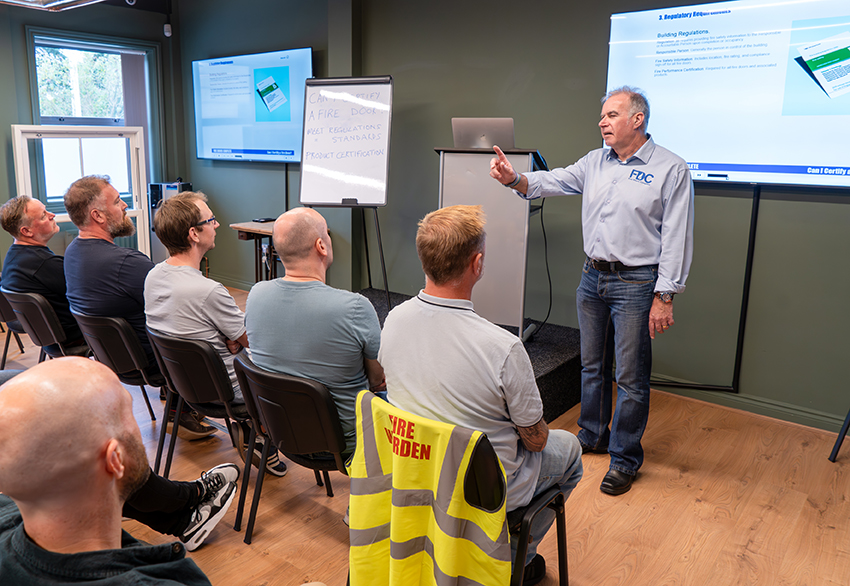
Course structure varies according to the subject. Some programmes are designed for remote study, allowing delegates to work through training materials from home or their workplace. Fire Doors Complete says most of its fire door training courses can be completed remotely, while classroom training is available at its training centre in Queniborough, near Leicester. The company can also provide training at a customer’s workplace.
More specialist training can involve a combination of self-study and classroom-based learning.
Its Fire Door Inspection Course, for example, combines home study with two days of in-person training and examination. Delegates receive a textbook and USB containing commentary and interactive self-tests before attending the examination. The course covers the role of the fire door, legislation, certification, regulations and standards, inspection requirements and record keeping.
Installation training can take a more practical approach. The BWF Fire Door Installation Awareness Course delivered by Fire Doors Complete is a two-day programme developed by the British Woodworking Federation and delivered by NOCN-approved training providers. It covers the importance of correct installation, legislation and guidance, pre-installation considerations and checks during and after installation.
For those who want to demonstrate practical competence, Fire Doors Complete also offers a practical installation assessment following theory-based installation training.
What accreditation should you look for?
This is an area where delegates should look beyond the word “accredited”.
FireQual operates a Recognised Programme route for training where a regulated qualification is not required or is not currently offered. Importantly, FireQual states that a Recognised Training Programme is not a regulated qualification. Instead, it provides external recognition of an appropriate programme of learning and assessment.
Fire Doors Complete is a FireQual-approved Training Centre for its Timber Based Fire Doors Awareness, Installation, Maintenance and Inspection programmes. It is also ISO 9001:2015 certified, with its accreditation information stating that its quality management system has been audited by a UKAS-accredited certification company.
The distinction matters. A recognised training certificate demonstrates successful completion of a particular programme. It should not automatically be presented as a regulated qualification or as proof of competence for every fire door-related role.
What should you take away from the training?
The real value of professional fire door training is what you can do with the knowledge afterwards.
You should have a clearer understanding of the role of fire doors within fire safety and be better equipped to recognise common issues. Depending on your course, that could mean carrying out installation work correctly, undertaking maintenance within your competence or conducting structured fire door inspections.
For facilities managers and Responsible Persons, the benefit can be equally practical. Training can help you understand what contractors are reporting, ask better questions and make more informed decisions about fire door maintenance and safety.
For installers and maintenance professionals, recognised training can provide documented evidence of learning that can be useful when demonstrating competence to employers or clients.
Professional training with Fire Doors Complete
Fire door safety depends on people having the right knowledge for the work they undertake. A professional fire door training course should be practical, evidence-based and relevant to the delegate’s responsibilities.
Fire Doors Complete offers training for people involved in fire door installation, inspection, maintenance and management. Its courses cover timber-based fire doors and are supported by FireQual-recognised programme approval.
- If you are unsure which course is appropriate for your role, contact the Fire Doors Complete team. The right training can give you a much clearer understanding of what good fire door practice looks like and why getting it right matters.