

A failed fire door inspection can feel alarming. It is also very common.
Analysis of more than 100,000 inspections carried out in 2021, found around three quarters of fire doors did not meet the required standard. The most frequent faults were incorrect gaps, incorrect or inadequate smoke sealing and poor care and maintenance.
So if your doors fail a fire door Inspection, you are far from alone. What matters is what you do next.
Our founder, Neil Ashdown, has worked with fire doors for decades. In that time we have seen the same pattern again and again. Most failed doors can be put right. Problems often start when faults are recorded and then left unresolved.
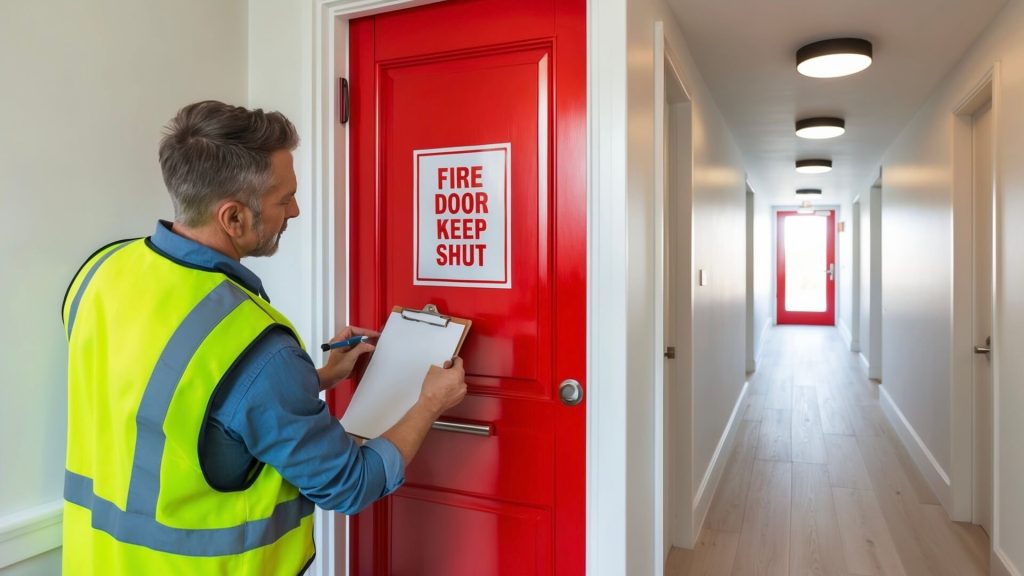
What happens if your fire doors fail an inspection?
If your doors fail a fire door Inspection, the inspector will record each defect and recommend remedial action. As the responsible person, you must arrange repairs or replacement without undue delay. Leaving known faults unresolved breaches the Regulatory Reform (Fire Safety) Order 2005 and risks enforcement action.
A failed result does not usually mean the fire service is on its way. It means you now hold written evidence of a problem. From that point, the law expects you to deal with it.
What are your legal duties as the responsible person?
In England and Wales, fire door regulations sit mainly within the Regulatory Reform (Fire Safety) Order 2005. The responsible person is usually the employer, building owner, landlord or managing agent with control over the premises.
Article 17 of the Fire Safety Order requires fire safety equipment to be kept “in efficient working order and in good repair”. Fire doors fall squarely within that legal requirement. A door that fails inspection is, by definition, not in efficient working order.
Extra rules for residential buildings over 11 metres
The Fire Safety (England) Regulations 2022 add specific fire door checks for multi-occupied residential buildings over 11 metres tall:
- Communal fire doors must be checked at least every three months.
- Flat entrance doors must be checked at least once a year, on a “best endeavours” basis.
- Residents must be informed of the importance of keeping fire doors shut, not to tamper with self-closers and to report faults.
For commercial buildings and smaller residential buildings, your fire risk assessment sets the frequency. Industry guidance from the BWF Fire Door Alliance suggests six-monthly checks as a sensible baseline for commercial premises. We explain this in more detail in our guide to how often fire doors should be inspected.

Why do fire doors fail inspections?
The most common failures come down to wear from regular use, poor installation or well-meant changes made without the right knowledge. The issues we see most often include:
- Excessive gaps. Where a fire door has no evidence of fire performance BS 8214: 2016 guidance recommends gaps of 2–4mm at the head and sides. Where smoke control is required, the threshold gap should be no more than 3mm. The difference between a pass and a fail can be just one or two millimetres. For fire doors fitted after April 2026 BS 8214: 2026 applies and does not mention the 2-4mm gap guidance as recommended in the 2016 version. Therefore, the evidence of fire performance for the door must be consulted. Where smoke control is required, BS8214:2026 states a flexible seal is required to seal the gap under the door.
- Missing or damaged seals. Intumescent seals expand in heat to close the gaps. Smoke seals stop cold smoke. Painted-over, torn or missing seals are a frequent fault.
- Faulty self-closers. The door must close fully and latch on its own from any angle. Doors propped open or closers that have been disconnected will fail.
- Worn or loose hinges. Missing screws or worn hinges cause the door to drop, which widens gaps.
- Damaged door leaves or frames. Holes, splits or unapproved alterations can undermine the door’s fire rating.
- Unsuitable glazing or hardware. Replacement locks, letterboxes or glass must match the door’s test evidence.
- Missing signage. Fire door signs are needed in many locations.
What should you do after a failed fire door inspection?
A clear plan protects your building occupants and shows you have taken your duties seriously. We recommend these steps:
- Read the report carefully. A good inspection report sets out each defect in plain English, with a recommended fix. Our own reports are written to be clear and jargon-free for this reason.
- Prioritise by risk. Doors on escape routes, stairwells and flat entrances usually come first. Ask your inspector if you are unsure.
- Put temporary measures in place. Remove wedges, reconnect closers and remind staff or residents to keep doors shut while repairs are arranged.
- Use competent people for the work. Repairs must follow the door manufacturer’s evidence of fire performance and any installation instructions. Swapping seals alone rarely fixes a door that has dropped or warped.
- Decide between repair and replacement. Many doors can be brought back into compliance by adjusting hinges, realigning the leaf or fitting suitable smoke control products. Others will need a replacement certified fire door that meets current fire door standards and requirements.
- Re-inspect and record everything. Keep dates, findings, who carried out the work and what was done. These records are your evidence the work has been carried out.
What are the legal penalties for ignoring fire door defects?
The fire and rescue service enforces the Fire Safety Order. If an audit finds fire door safety problems that have not been dealt with, it has several options.
Enforcement notices
An enforcement notice sets out where you have failed to comply and what must be done. You will be given at least 28 days to put things right.
Prohibition notices
Where the risk is serious, the fire service can restrict or stop the use of all or part of a building. If the risk of serious injury is imminent, this can take effect immediately. For business owners, that can mean closing premises until the work is done.
Fines, prison and personal liability
Under Article 32, failing in your fire safety duties is an offence where it puts people at risk of death or serious injury. So is ignoring an enforcement notice.
- Cases heard in the Crown Court can lead to an unlimited fine, up to two years in prison or both.
- Directors and managers can be held personally liable where an offence results from their consent, connivance or neglect.
The most serious consequence is not legal at all. In the event of a fire, a faulty door can allow the spread of fire and smoke into escape routes. That is the risk the law exists to prevent.
How can you avoid failing your next fire door inspection?
Fire doors are one part of your building’s fire protection, working alongside your fire alarm and other measures. Like any fire protection system, they need regular inspections and ongoing fire door maintenance to stay effective.
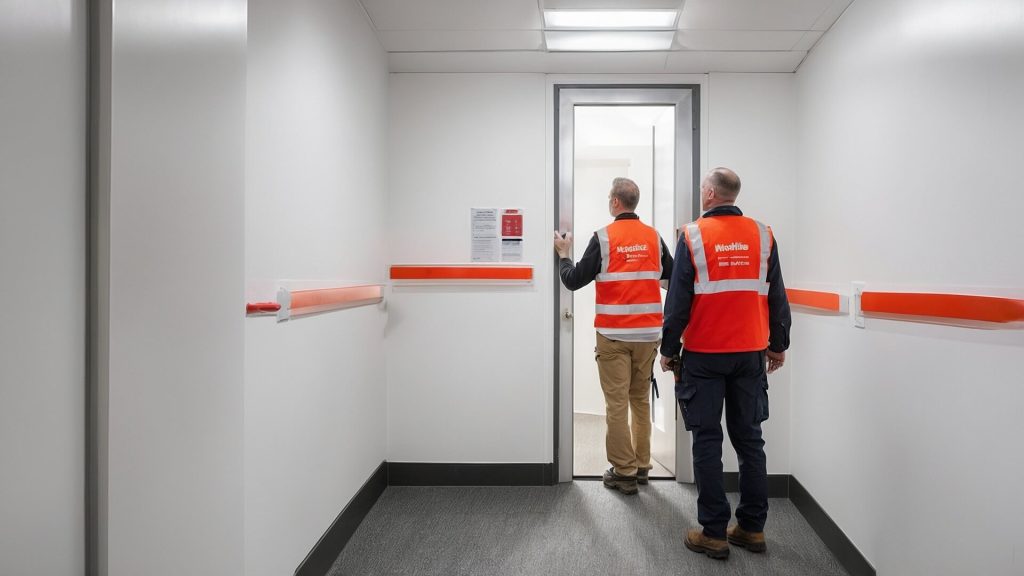
A simple fire door checklist for in-house checks
Between professional annual inspections, a facilities manager or caretaker can use a basic inspection checklist:
- Does the door close fully and latch from any open position?
- Are the gaps even and no bigger than 4mm at the head and sides?
- Are the intumescent seals and smoke seals present and undamaged?
- Are all hinges secure, with no missing screws?
- Is the door free from wedges, holes and unapproved alterations?
Regular checks like these catch most problems early. Record what you check and report anything unusual. Busy doors may need more frequent inspections than your minimum legal requirement.
Build competence in your team
In-house checks are only as good as the people doing them. Our training courses, including our Awareness and Maintenance Training Modules, help your team spot problems early. Our programmes are FireQual-recognised and we are ISO 9001:2015 certified.
Get clear answers from fire safety professionals
If a recent check has raised concerns, or your fire doors have not been inspected for a while, we can help. Our fire door inspections give you a clear, jargon-free report on the condition of each door, with recommendations for any remedial work needed. Where new doors are required, our consultancy and specification service can help you get them right first time.
For peace of mind that your doors meet current fire safety standards, call us on 07599 425388 or email robin@firedoorscomplete.com.