

How often to inspect fire doors is a question that can have serious consequences for anyone responsible for fire safety in a building. Leave inspections too long and defects can go unnoticed. Inspect them too often without understanding what the law actually requires and you may be wasting time and resources.
So what does the law say?
For certain residential buildings, the answer is very specific. Under the Fire Safety (England) Regulations 2022, fire doors in the common parts of residential buildings over 11 metres high must be checked at least every three months. Flat entrance fire doors must be checked at least once every 12 months, using best endeavours to gain access.
For commercial premises and residential buildings below 11 metres, there is no equivalent fixed statutory interval. That does not mean fire door inspections can be left until someone notices a problem. The Regulatory Reform (Fire Safety) Order 2005 places an ongoing duty on the responsible person to ensure fire safety measures are maintained in efficient working order and in good repair.
The right inspection frequency depends on the building, how its fire doors are used and the risks identified in the fire risk assessment.
Getting that frequency right matters. A fire door has a critical role in helping prevent the spread of fire and smoke and protecting escape routes. If it is damaged, poorly maintained or unable to close properly, its ability to perform that role can be seriously compromised.
So, how often should fire doors be inspected? Let’s look at what the law actually requires.
What the law says about fire door inspections
There are two key pieces of legislation to understand when considering fire door safety in England.
The Regulatory Reform (Fire Safety) Order 2005, generally known as the Fire Safety Order, sets out the main fire safety duties for non-domestic premises and the common parts of multi-occupied residential buildings. The responsible person must take appropriate fire safety measures and ensure that relevant equipment and devices are maintained in efficient working order and in good repair.

The Fire Safety (England) Regulations 2022 introduced additional duties for certain residential buildings. They came into force on 23 January 2023 and followed the recommendations of the Grenfell Tower Inquiry.
Among other requirements, Regulation 10 introduced specific intervals for checking fire doors in residential buildings over 11 metres.
This distinction is important. There is no single inspection frequency that applies to every fire door in every building. The legal position depends on the type of building and, in some cases, its height.
How often to inspect fire doors in residential buildings over 11 metres
If you are the responsible person for a residential building over 11 metres in height, the Fire Safety (England) Regulations 2022 set specific requirements for fire door checks.
Fire doors in the common parts must be checked at least every three months.
The responsible person must also use best endeavours to check flat entrance fire doors at least every 12 months.
The quarterly requirement applies to communal fire doors in areas such as corridors, lobbies and stairways. These doors are an important part of the building’s fire protection strategy and need to be kept in good condition.
The three-month period is a legal minimum. It should not automatically be treated as the ideal inspection frequency for every building. If a fire risk assessment identifies specific risks, more frequent checks may be appropriate.
For example, a door that receives heavy daily use or has a history of damage may warrant more frequent attention than one in a lightly used area.
The annual checks of flat entrance doors are subject to the best endeavours requirement because the responsible person may not have unrestricted access to individual flats. Residents should be given reasonable opportunities to provide access and appropriate records should be kept of the steps taken.
What about residential buildings below 11 metres?
The Fire Safety (England) Regulations 2022 do not impose the same quarterly and annual fire door check intervals on residential buildings below 11 metres.
That does not remove the need for regular fire door checks.
The Fire Safety Order continues to place duties on the responsible person in relevant multi-occupied residential buildings. Fire doors form part of the building’s fire safety measures and need to be maintained in good repair and efficient working order.
The appropriate frequency should be determined through the building’s fire risk assessment.
This is where a sensible inspection programme becomes important. A low-rise block of flats with relatively little footfall may present different risks from a busy residential building with communal doors being used throughout the day.
The building type, condition of the doors and specific fire hazards should all be taken into account.
How often do commercial buildings need fire door checks?
There is no fixed statutory inspection frequency for fire doors in most commercial premises.
That includes buildings such as offices, shops, warehouses, factories, schools and care homes.
Instead, the responsible person must ensure appropriate fire safety measures are in place and maintained. The frequency of fire door inspections should be based on the findings of the fire risk assessment.
Industry best practice can provide a useful benchmark. The British Woodworking Federation Fire Door Alliance recommends regular inspections, with six-monthly checks commonly used as a baseline in many commercial environments. More frequent checks may be appropriate where doors are subject to particularly heavy use or other specific risks.
The important point is that six months should not be presented as a universal legal requirement. It is guidance that can help building owners and responsible persons establish a defensible inspection regime.
A busy stairwell door in a commercial building may need considerably more frequent routine checks than a fire door in an area with very little traffic.
What does a fire door inspection involve?
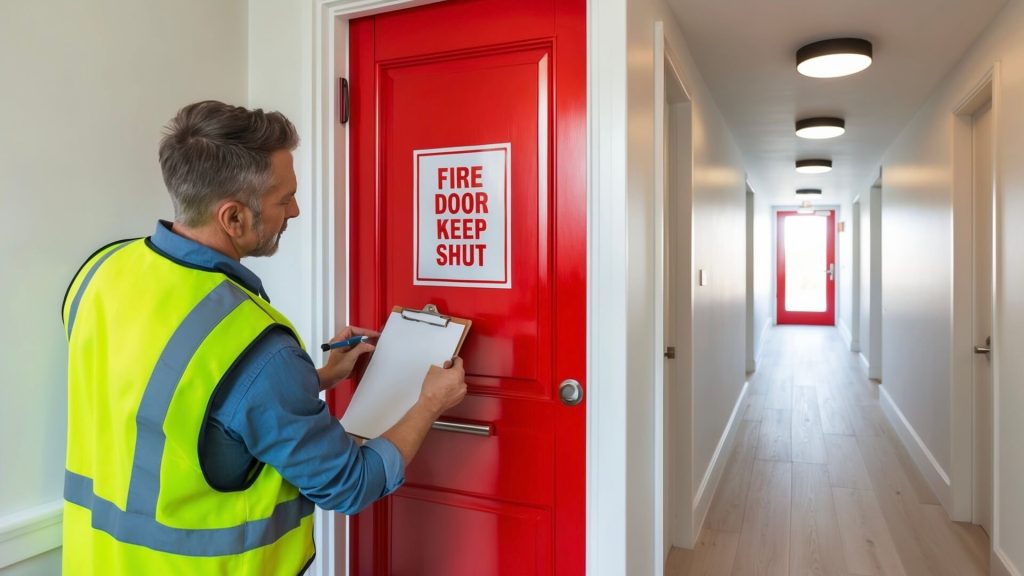
An adequate fire door inspection is considerably more than looking at whether the door appears to be in good condition.
A competent person will assess the doorset or assembly and look for defects that could affect its performance in the event of a fire.
Depending on the door and its specification, this can include checking the door leaf and frame, gaps around the door, hinges and fixings, the self-closing device, glazing and glazing beads, locks and latches and the condition of intumescent seals and smoke seals.
The door should close fully into its frame without assistance. Any obvious damage should be investigated and defects should be recorded so that appropriate remedial action can be taken.
It is also important to remember that fire doors are tested as complete assemblies. Replacing components with unsuitable alternatives or making unauthorised alterations can affect how the doors function.
A professional inspection should establish what is non-compliant, where it is non-compliant and what action needs to be taken.
Who can carry out fire door checks?
The person carrying out fire door checks should be competent for the task.
For routine checks, a suitably trained building manager, caretaker or another member of the responsible person’s team may be able to carry them out.
A detailed fire door inspection is different. Where a building contains a large number of fire doors or there are concerns about their condition, using a suitably qualified specialist provides a more thorough assessment and a clear record of findings.
Keeping records of fire door checks
Record keeping is an important part of fire safety management.
For residential buildings over 11 metres, the Fire Safety (England) Regulations 2022 require the responsible person to record the checks of fire doors in the common parts and the steps taken to use best endeavours to check flat entrance doors.
Records should make it clear when checks were carried out, who carried them out and what was found. Where defects are identified, there should also be a record of the action taken.
Good records provide evidence that an appropriate fire door inspection regime is being followed. They can also make it much easier to identify recurring problems and ensure remedial work is completed.
What happens if fire doors are not inspected?
Failing to meet fire safety duties can have serious consequences.
The Fire Safety Order gives fire authorities the powers to take enforcement action where fire safety requirements are not being met. Depending on the circumstances, this can include enforcement notices, prohibition notices and prosecution.
There is also the more immediate concern of building safety.
A fire door that has deteriorated, has damaged intumescent seals or no longer closes correctly may fail to provide the fire protection it was designed to deliver. If an emergency occurs, that can have consequences for the people relying on the building’s fire safety measures.
Regular checks and appropriate fire door maintenance are essential to ensuring that fire doors remain capable of doing their job.
Fire door inspection frequency: getting it right
For residential buildings in England over 11 metres, the legal minimum is clear: communal fire doors must be checked at least every three months and flat entrance fire doors at least every 12 months using best endeavours.
For commercial premises and residential buildings below 11 metres, there is no equivalent fixed statutory interval. The frequency should be determined by the fire risk assessment and the specific circumstances of the building.
Whatever the building type, routine checks should form part of an effective fire safety regime. Where a detailed assessment is required, a professional fire door inspection can identify problems that routine checks may miss and provide a clear record of the condition of the doors.
Need your fire doors inspected?
Fire Doors Complete provides professional fire door inspections and surveys for residential and commercial buildings.
Our inspections give responsible persons a clear picture of the condition of their fire doors, identify defects requiring attention and provide detailed documentation to support ongoing fire safety management.
If you are responsible for a block of flats, commercial premises or another building containing fire doors, we can help you establish an appropriate inspection programme and keep your fire doors in good working order.
For more information, call 07599 425388, email robin@firedoorscomplete.com or contact Fire Doors Complete through the website.